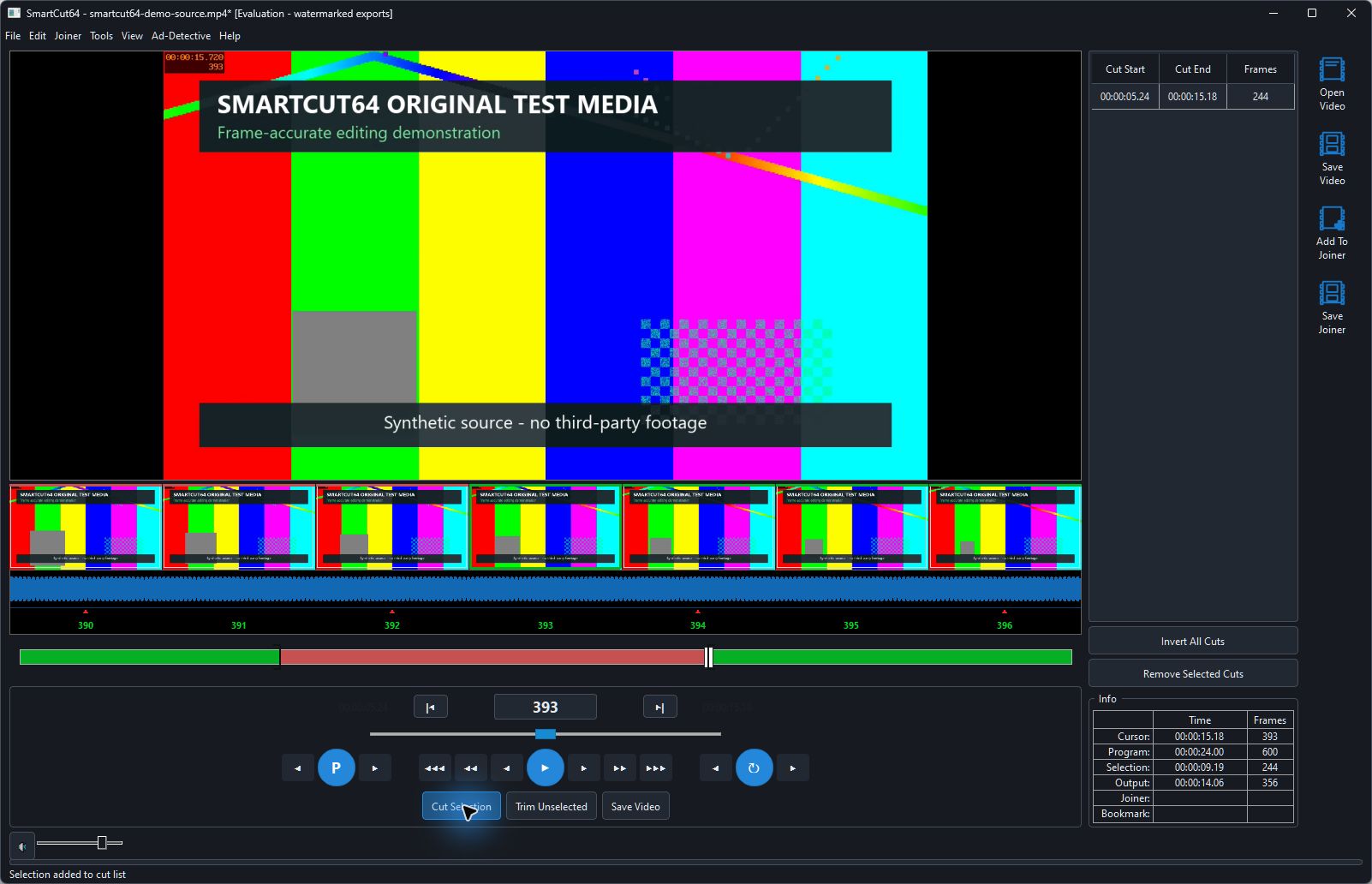
Plan before writing
For each kept range, SmartCut64 identifies codec random-access points, dependency pictures, selected streams, timestamp relationships and destination-container rules. Interior compressed packets are reusable only when that plan proves they can be delivered safely.
Encode the boundary, copy the interior
If an exact cut falls inside a GOP, unsafe boundary pictures are decoded and encoded with the validated software encoder. Safe complete GOPs between boundaries are copied without generational video loss. Smart-render boundary encoding deliberately remains software-only even when full-transcode hardware encoding is enabled.
When full transcode is required
- Evaluation watermarking
- A requested codec, frame size, frame rate or picture-processing change
- A profile explicitly set to Force Recode
- A source/destination combination whose reusable packets cannot satisfy the output rules
Validation
The output is checked for structure, stream policy, timing, expected frames and applicable copied-payload/metadata evidence. SmartCut64 reports completion only after the temporary delivery passes those gates.